- Arm Count
- 2.0
- LeRobot Support
- Yes
- Payload Capacity
- 4.0 kg
- Teleoperation method (reported)
- VR teleoperation via WebXR from any compatible headset (Meta Quest documented, incl. wired Quest-over-USB and remote teleop over Tailscale); gravity-compensation hand-guiding and a browser control panel as alternatives. No leader arms.
- Mobile Base
- No
Overview
Axol is a dual-arm manipulation platform from Almond, a Y Combinator-backed hardware startup that designs and assembles the robot in San Francisco. It is aimed at teams collecting demonstration data and training manipulation policies for real deployments rather than lab demos. Each of the two arms has 7 degrees of freedom, 860 mm of reach and a wrist with full 180 degrees of pitch and yaw, which Almond says reduces shoulder singularities and enlarges the usable workspace. Peak payload is 6.5 kg per arm with a 4 kg nominal (sustained, non-thermally-throttled) rating. Repeatability is 1 mm and the robot itself weighs 19.5 kg. Motors run on a 500 Hz CAN bus exposed over a single locking USB-C connector, with XT90 power in from the included 1500 W (24 V, 62.5 A) supply. Construction is steel, aluminium and TPU with internally routed cabling, powder-coated matte black. Axol ships fully assembled with two 2-finger grippers whose tips are swappable (or the whole gripper can be replaced; gripper drawings and a STEP CAD model are published). It bolts down with four M8x12 bolts to a customer fixture, to the Axol Mount (a 400 mm 8080 T-slot column) or to the Axol Cart, a height-adjustable manually-rolled cart with leveling casters and a 60x60 cm footprint that fits through standard doors. The cart is manually repositioned - Axol has no driven mobile base. The optional Perception Kit adds 2x ZED X One S wrist cameras, 1x ZED X Mini head camera, all FAKRA GMSL2 cabling and mounts, and a ZED Box Orin NX 16GB for onboard compute. The robot body has GMSL2 ports and camera mounting holes for wrist and head cameras built in, so the kit is a bolt-on rather than a redesign. Software is an MIT-licensed open-source Python SDK and CLI (github.com/almond-bot/axol) covering low-level CAN motor control, a bimanual inverse-kinematics solver (pyroki/JAX), ZED camera streaming, LeRobot bindings for dataset collection and policy inference, a joint-tuning toolkit, a browser control panel, a diagnostics dashboard and a viser-based simulator. Teleoperation is VR-only: a WebXR app runs on any compatible headset (Meta Quest is documented, including a low-latency Quest-over-USB transport and remote teleop over Tailscale). There are no leader arms; gravity-compensation hand-guiding is offered as an alternative input. No ROS or ROS 2 integration is published.
Highlights
- 2x 7-DoF arms, 860 mm reach per arm, wrist with full 180 degrees pitch and yaw for reduced shoulder singularities
- Payload: 4 kg nominal (sustained, no thermal throttling) and 6.5 kg peak per arm
- 500 Hz CAN control over a single locking USB-C connector; XT90 power from an included 1500 W supply
- MIT-licensed open-source Python SDK and CLI: bimanual IK, CAN motor control, LeRobot bindings, joint tuning, web control panel, viser simulator
- WebXR VR teleoperation from any compatible headset (Meta Quest documented, incl. wired Quest-over-USB and remote teleop over Tailscale)
- Optional Perception Kit: 2x ZED X One S wrist cameras, 1x ZED X Mini head camera, ZED Box Orin NX 16GB compute (+$3,249)
- Mounting options: standalone, Axol Mount T-slot column (+$199) or height-adjustable manual Axol Cart (+$999)
- Ships fully assembled with 2x 2-finger grippers with swappable tips; gripper STEP CAD and drawings published
- Designed and assembled in San Francisco; from $7,999
Specifications
Configuration
- Arm Count
- 2.0
- Teleoperation method (reported)
- VR teleoperation via WebXR from any compatible headset (Meta Quest documented, incl. wired Quest-over-USB and remote teleop over Tailscale); gravity-compensation hand-guiding and a browser control panel as alternatives. No leader arms.
- Mobile Base
- No
- Leader Arms Included
- No
Software & Ecosystem
- LeRobot Support
- Yes
- Onboard Compute
- ZED Box Orin NX 16GB (NVIDIA Jetson Orin NX, 16 GB) - included with the optional Perception Kit (+$3,249); no compute in the base configuration.
- ROS/ROS 2 Integration
- No
- Open-Source Assets Included
- MIT-licensed Python SDK + CLI (github.com/almond-bot/axol): bimanual IK solver (pyroki/JAX), low-level CAN motor interface, WebXR VR teleop app, ZED camera streaming, LeRobot bindings, joint-tuning toolkit, web control panel, diagnostics dashboard, viser simulator. Public CAD: gripper.step, wrist_mount.step, head_mount.step plus mounting-hole and gripper PDF drawings. No URDF published.
Per-Arm Specs
- Payload Capacity
- 4.0 kg
- Arm Degrees of Freedom (per arm)
- 7.0
- Maximum Reach
- 860.0 mm
- Repeatability
- 1.0 mm
Perception
- RGB Camera Count
- 2.0
- RGB-D Camera Count
- 1.0
General
- Control Loop Frequency
- 500.0 Hz
- End-effector options
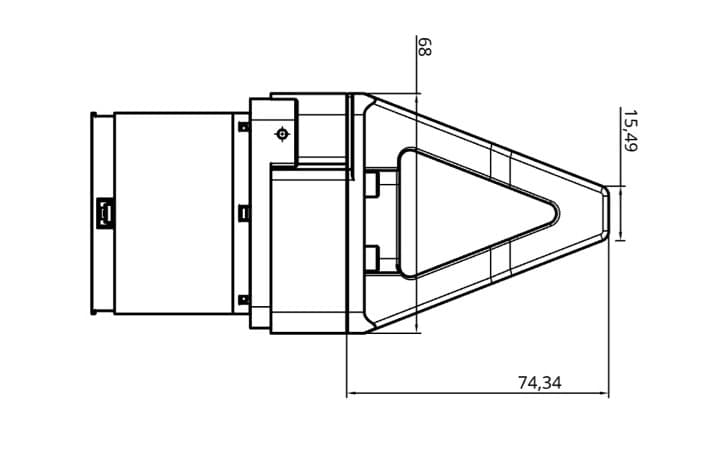
- 2-finger gripper (2 included, one per arm); replaceable fingertips or full gripper swap. Deselecting grippers reduces price by $950.
- I/O Ports
- 1x locking USB-C (CAN control), 1x XT90 (power), 2x FAKRA GMSL2 (wrist cameras).
- Motor Communication Interface
- CAN bus (SocketCAN) at a 500 Hz control rate.
- Mounting Interface
- 4x M8x12 bolts threaded in from underneath, with locking washers.
- Mounting Pattern
- Mounting holes provided at the base, the wrist cameras and the head camera.
- Payload Definition (Nominal)
- 4 kg per arm - sustained load without thermal throttling.
- Payload Definition (Peak)
- 6.5 kg per arm - peak / short-duration load.
- Peak Current
- 60.0 A
- Peak Payload Capacity
- 6.5 kg
- Structural Materials
- Steel, aluminium and TPU, with internally routed cabling.
- Supply Voltage
- 24.0 V
- Weight
- 19.5 kg